CDT researcher wins Young Engineer Prize for turning satellite signals into rainfall sensors
A PhD researcher on the CEPS CDT programme at the University of Cambridge has won a young engineer award for research exploring how satellite communication signals could help monitor rainfall and improve weather monitoring.
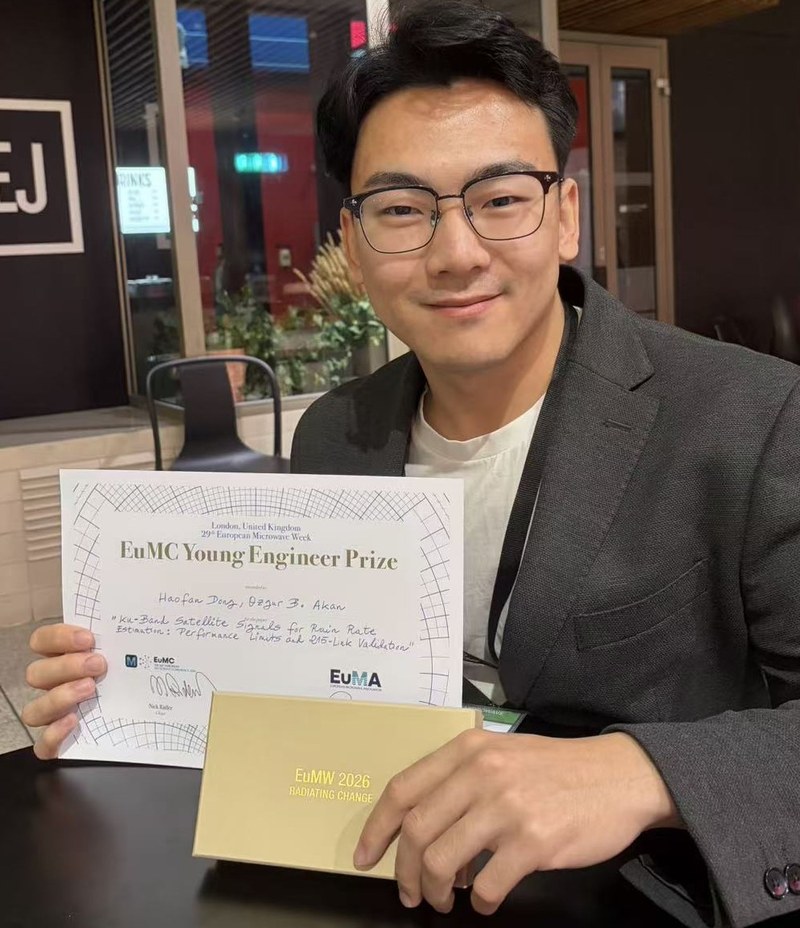
Haofan Dong, a doctoral researcher within the Centre for Doctoral Training (CDT) in Connected Electronic and Photonic Systems (CEPS), received the EuMC Young Engineer Prize at the 2026 European Microwave Conference at Excel in London in October 2026.
His award-winning paper, ‘Ku-Band Satellite Signals for Rain Rate Estimation: Performance Limits and 215-Link Validation’, was co-authored with his PhD supervisor, Professor Özgür Akan, at the University of Cambridge.
The research investigates how signals transmitted by existing satellite communication systems could be used as a complementary source of information to estimate rainfall and improve weather monitoring.
Turning a communications challenge into a sensing opportunity
Rain weakens radio signals travelling between satellites and ground-based receivers. For satellite communications engineers, this attenuation is normally an effect to be compensated for, since it can degrade the quality and reliability of a communications link.
Haofan’s research explores how the same effect could instead provide useful information about the atmosphere. By measuring how much a satellite signal weakens as it passes through rain, it may be possible to estimate the rainfall rate along its path. The challenge is to distinguish the effect of rainfall from other factors that influence signal strength, including weather conditions and receiver calibration.
The team studied the limits of how accurately rainfall can be estimated from these signals and compared predictions from a propagation model with real measurements. The comparison used 25,398 rainy samples from 40 representative geostationary Earth orbit (GEO) links in southern France, drawn from the 215-link OpenSat4Weather dataset, alongside corresponding weather-radar observations.
The comparison supports the model’s predicted relationship between rainfall and signal attenuation, providing evidence for the potential of satellite communication links as a source of complementary weather information.

Making better use of existing infrastructure
The longer-term ambition is to supplement established rainfall-monitoring methods, such as weather radar and rain gauges, with measurements derived from satellite communications infrastructure.
Because these systems are already transmitting signals for communication, they could potentially provide additional environmental information without requiring a dedicated sensing network. Such measurements could be particularly valuable in areas where ground-based weather-monitoring coverage is limited.
The research illustrates a wider opportunity in wireless engineering: signals designed to carry information from one place to another can also reveal information about the environment through which they travel.
Recognition for wider research in satellite and wireless systems
The award was one of two notable achievements for Haofan at European Microwave Week 2026. He also presented research on using orthogonal frequency-division multiplexing (OFDM) radar for space-debris sensing at the European Radar Conference (EuRAD), where the paper was shortlisted for its Young Engineer Prize.
Haofan is pursuing his PhD through the Centre for Doctoral Training (CDT) in Connected Electronic and Photonic Systems (CEPS) at the University of Cambridge, supervised by Professor Akan. His research focuses on integrated sensing and communications for space and satellite networks, using estimation theory and statistical signal processing to investigate what wireless signals can reveal about their surroundings and how hardware imperfections affect measurement reliability.
He has also gained industry experience through a research internship at Nokia Bell Labs Cambridge, where he worked on modelling and optimisation for advanced wireless systems.
In addition to the European Microwave Conference award, Haofan has been selected to receive the 2026 IEEE Signal Processing Society Scholarship, recognising his academic preparation, research potential and commitment to the field of signal processing.
Reflecting on the two achievements, Haofan said: ‘Receiving these two recognitions has made me very happy and encouraged me to keep exploring how communication signals can help solve practical sensing problems.’
His achievements highlight the quality and practical relevance of research being undertaken by doctoral researchers on the CDT programme.
Find out more
Haofan Dong is a PhD student at the University of Cambridge on the EPSRC Centre for Doctoral Training in Connected Electronic and Photonic Systems (CEPS CDT) programme. His PhD research focuses on integrated sensing and communications for space and satellite networks, supervised by Professor Ozgur Akan.
Connect with Haofan Dong: https://cxc.eng.cam.ac.uk/people/haofan-dong
Original article by Michael Shuff, University of Cambridge: https://elec.eng.cam.ac.uk/news/cambridge-phd-researcher-wins-eumc-prize-for-turning-satellite-signals-into-rainfall-sensors/
Photo credit: © Xiaofang Wen, University of Cambridge, 2026.
Technology illustration: Generated using OpenAI image generation.
Published: November 2026.