
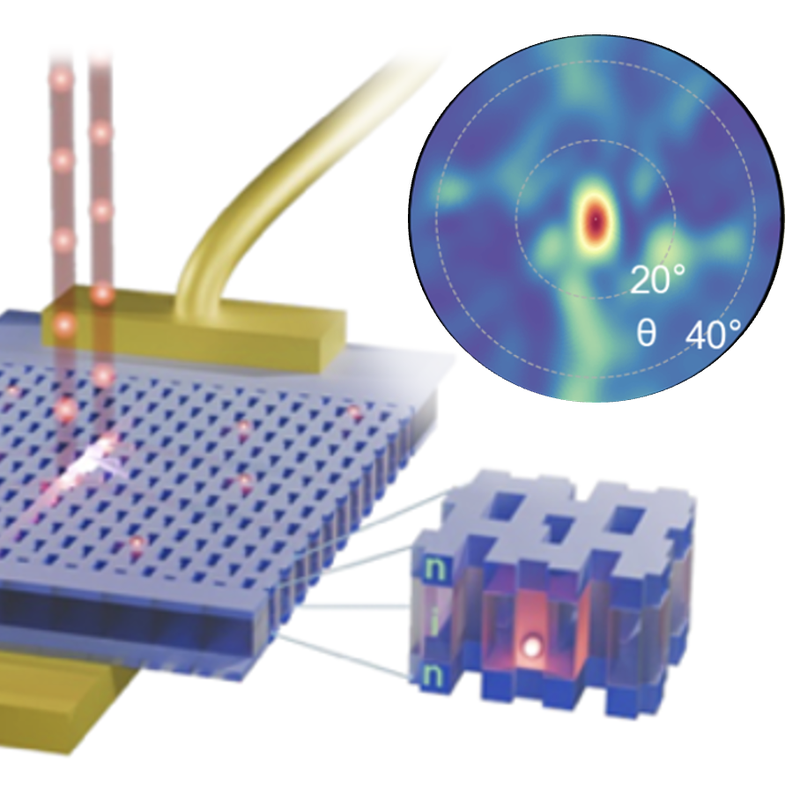
Research paper highlights a new approach to spectrally aligning light emission from GaAs Quantum Dots using Electrically Tuneable Nonlocal Metasurfaces
A recently published scientific study, led by Dr Samuel Prescott at UCL, in collaboration with a research team at Sandia National Laboratories (USA), demonstrates a metasurface platform enabling spectral alignment of emission wavelength for a pair of sparse quantum dots, while also improving the emitted photon outcoupling efficiency.
Making Quantum light work together
Quantum dots, nanoscale semiconductor structures, can generate single photons making them promising building blocks for future quantum information technologies. One of the most intriguing possibilities is cooperative photon emission, a quantum effect where multiple quantum emitters work together in a coordinated way. But in practice, getting semiconductor quantum dots to emit light at exactly the same wavelength is extremely difficult. Each dot is slightly different, and even small variations break the condition of indistinguishability needed for cooperative effects.
Research by Dr Prescott, published in Nano Letters, takes an important step toward overcoming this challenge.
A new approach: Electrically‑Tuneable Nonlocal Metasurfaces
The team developed a nonlocal metasurface, a thin layer of nanostructured material with specially engineered optical properties, which can be tuned electrically. When GaAs quantum dots integrated into the metasurface emit photons they can couple to a common extended metasurface mode. Crucially, the electrical tunability allows bringing two separate dots, naturally emitting at slightly different wavelengths, into precise spectral alignment. At the same time, the metasurface provides a channel for photons from the quantum dots to be emitted into free space more efficiently.
Why this matters
This functionality could be used in future quantum technologies. Because each quantum dot has a slightly different dipole moment, they respond differently to the electrical tuning provided by the metasurface. This natural variation becomes an advantage: by adjusting the device, we can shift the emission wavelengths until two distant dots produce photons of the same colour.
The result is striking
Two GaAs quantum dots integrated into the metasurface can be tuned with the same applied voltage to emit at the same wavelength. This alignment is a key prerequisite for observing cooperative photon emission in solid‑state systems. At the same time, free‑space photon outcoupling is significantly enhanced, bringing quantum dot technologies closer to practical quantum‑light applications.
Read the full published research paper: “Voltage-Tunable Nonlocal Metasurface for Enhanced Outcoupling of Emission from Quantum Dots" by Samuel Prescott, Prasad P. Iyer, Sanghyeok Park, Stephanie Malek, Jiho Noh, Pingping Chen, Chloe F. Doiron, Sadhvikas Addamane, Igal Brener, Oleg Mitrofanov, in Nano Lett. January 20, 2026, DOI: 10.1021/acs.nanolett.5c04834.
Dr Samuel Prescott was awarded his PhD from UCL on the EPSRC Centre for Doctoral Training in Connected Electronic and Photonic Systems (CEPS CDT) programme. His PhD research, supervised by Professor Oleg Mitrofanov, was funded by EPSRC programme grant EP/S022139/1.
Image: Illustration of developed nonlocal metasurface with details of nanoscale design and simulated emission pattern. Image © UCL 2026.
Samuel Prescott's publication list on Google Scholar.